|
"Buying and Selling Collectibles for 60 Years" by Tom Orr My journey started on a summer afternoon
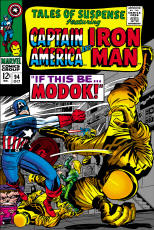
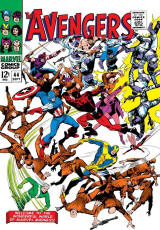
in 1967, when I plunked down 12 cents each for Tales of Suspense #94
and Avengers #44 at a little Mom and Pop store in West Hazleton,
Pennsylvania, and lead to a lifelong avocation and profession that
had me on the phone with collectors like Billy Crystal, Penny
Marshall, Eddie Vedder, James Earl Jones, and more.
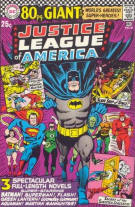
Let me try to recreate a little of the time, for those younger than me. We thought we were so modern, and on the verge of a new era, even without computers and cell phones. We had three TV stations. With only Gilligan's Island and The Beverly Hillbillies, how was a young kid supposed to learn about being a teenager? I was an avid reader of the comics section of the newspaper. My first comic books were Archie Comics (oh, Betty & Veronica!). But after a short while, they became childish. When I saw the first episode of the Batman TV show, I knew this genre was for me. I wanted to see the character treated more seriously, though. DC Comics would feature Batman prevalently on their covers because of the show, so I purchased an 80 page Giant Justice League of America, and I knew I was onto something, but there was still something missing. There was something old-fashioned about their heroes. They were like your parents heroes: all white, mostly male, upright, and flawless. I grew up in Levittown, the
quintessential American suburb of the 60's. We had the first modern
convenience stores like 7/11 were I could find comics, but it was
best when our family of 7 packed our 1959 Chevy station wagon, and
headed upstate to visit our grandparents. Hazleton PA was the fourth
largest city in the state, and sitting on a mountain, the highest.
It's Victorian houses and old brownstones made you feel like you
were in an era 20 years older. Every block still had the classic
"Mom and
I found out that modern Marvel Comics only started in 1961, so I had to collect them all. I found a few friends around Levittown who read Marvel Comics, and we were like a secret society. For instance, I eventually found Avengers #1 thru #43 by trading with my friends or sending away for them in the mail. Howard Rogofsky and Robert Bell would advertise their catalogs for 10 cents in the comics. At that time comics from the 40's. that are worth thousands now, were in the Rogofsky catalog for $15 or $20. An Avengers #1 was $6.50. (Remember that a comic was 15 cents, so paying $2 for a comic that was only a few years old seemed like a lot). I soon had all the Marvel Comics back to 1961 in original, or in reprint. I didn't realize I was in the middle of a revolution that changed comics. I just loved Stan Lee, Jack Kirby, Steve Ditko, John Romita, and John Buscema. I was able to identify all the Marvel artists and inkers by their style and pencil or brush strokes. I was reading encyclopedias when I was 6, so I loved cataloging and archiving my collection. I had a list of them all, including condition. I wanted to know about the history of comics. The best books at the time were Jules Feiffer's "The Great Comic Book Heroes" and Jim Steranko's History of Comics. I found out that the first superhero comics were in 1939, Action Comics #1(the first Superman), and Marvel Comics #1 (featuring the Human Torch and the Sub-Mariner). It seems the largest percentage of the population read comics in the 30's and 40's, the Golden Age of comics. The Depression and WWII called for light throwaway fare. Sales of Superhero comics plummeted afterward the war, due also to the Werthem witch hunt that corresponded with the McCarthyism of the 50's. American's also had this new thing called television to keep them occupied. It was against this background that in 1961, Stan Lee and Marvel started the "Superheroes with super-problems" formula that popularized them with modern audiences. By 1970, Spider-Man was selling as many comics as Superman.
1970 also brought the first Overstreet Comic Book Price Guide. By that time, I had 95% of the Marvel Comics of the 60's (Now called the Bronze Age). Going by the book, I figured my collection was worth over $2,000! (Today their worth would have been, who knows, maybe $100,000). In 1973, I graduated from high school in 1973. It was also the year that disaster struck. A leak in my bedroom window somehow trickled down to my comic collection, that was carefully stored beside my bed. I was devastated. I was so upset, I decided to give up comics. I was entering the University of Pennsylvania that fall, so I figured that I wouldn't have time for comics. I sold my collection to a friend for $200, which I thought was a fair price considering that so many had water damage. Besides, I needed money for school (sigh), but I didn't realize that comics would still come back to be a big part of my life.
That fall, my first semester at Penn, me and a buddy took the bus to check out Center City Philly. We were walking down Walnut Street, when my jaw dropped to the ground like a Warner Brothers cartoon. Right in front of me was the first COMIC BOOK STORE that I had ever seen! No more searching every convenience store to find them all. Right there was every new comic neatly displayed, boxes and boxes of back issues, and $10 to $20 comics displayed on the wall. It was like a Howard Rogofsky catalog come to life! Needless to say, it wasn't long before I had started on a whole new collection. These stores were starting to
pop up all over the country, soon replacing newsstands as the number
one place for new comics. In Philly there was Fat Jack's Comic
Crypt, or Comic Investments. By 1980, I was working at Riverfront
Dinner Theatre doing as many as 9 shows a week. I was living in
Northeast Philly by then, and Comic Investments had moved there as
well. I needed a flexible part-time job to go with my acting. Since
I was one of his most knowledgeable customers, (and that's saying a
lot considering the geeks in a comic store), the owner, Ron Oser,
hired me. In the next decade he had
|

 Pop"
store, no bigger than your living room. They each had a few shelves
of canned goods, soda, ice cream, and of course the glass case with
"penny" candy. But the main attraction was the spinning comic book
rack. These stores had complete newsstands were you could pick up
the latest magazine or newspaper every day. Very tame black & white
"Men's" magazine were kept behind the counter. Our favorite was two
blocks down the street from my
Pop"
store, no bigger than your living room. They each had a few shelves
of canned goods, soda, ice cream, and of course the glass case with
"penny" candy. But the main attraction was the spinning comic book
rack. These stores had complete newsstands were you could pick up
the latest magazine or newspaper every day. Very tame black & white
"Men's" magazine were kept behind the counter. Our favorite was two
blocks down the street from my
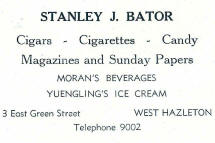 grandparents,
Bator's Store. Grandpa would ask me to pick up the newspaper, and
he'd give me a dollar in change. I would come back with the
newspaper, a Dr. Pepper, some Tastycakes, and several comic books.
It was on one of those excursions that I decided to pick up two
comics, Tales of Suspense #94 and Avengers #44, about characters
that I had never heard of from Marvel Comics, because the art on the
covers by Jack Kirby and John Buscema, just jumped out at me. They
seemed more dynamic than the DC Comics, and when I read them I was
hooked. The stories had a humor and maturity that I was looking for.
Marvel heroes had real-life problems. Needless to say, Bator's Store
became my comic book Mecca. I can still smell the newsprint as Mrs.
Bator cut the string around the latest batch. Grandpa would soon be
sending me comics from Hazleton that I couldn't find in Levittown. I
even convinced Mom to make them my Christmas present (
grandparents,
Bator's Store. Grandpa would ask me to pick up the newspaper, and
he'd give me a dollar in change. I would come back with the
newspaper, a Dr. Pepper, some Tastycakes, and several comic books.
It was on one of those excursions that I decided to pick up two
comics, Tales of Suspense #94 and Avengers #44, about characters
that I had never heard of from Marvel Comics, because the art on the
covers by Jack Kirby and John Buscema, just jumped out at me. They
seemed more dynamic than the DC Comics, and when I read them I was
hooked. The stories had a humor and maturity that I was looking for.
Marvel heroes had real-life problems. Needless to say, Bator's Store
became my comic book Mecca. I can still smell the newsprint as Mrs.
Bator cut the string around the latest batch. Grandpa would soon be
sending me comics from Hazleton that I couldn't find in Levittown. I
even convinced Mom to make them my Christmas present (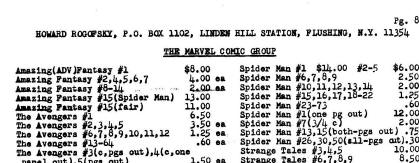

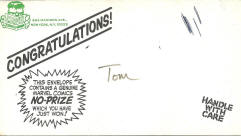 In
1970, I received a coveted No-Prize for pointing out some sort of
story error. (They were empty envelopes, in case you were wondering,
worth over $500 as a collectible nowadays). The same year, I wrote
Stan Lee explaining that I was an academic student looking at
different future careers, and that I would like to drop by their
office and show them my artwork, and discuss the business. To my
surprise, they said yes, and a tall skinny 15 year old kid was on a
train by himself for his first trip to New York City. I found my way
to the small , cluttered 6th floor office on Madison Avenue without
a problem. I was supposed to see John Romita, but he hadn't come
into work that day, so I spent the time talking about comics and how
they are made, with Marie Severin and John Veerporten, and showing
them my artwork. They treated me with a lot of respect and
sent me home with a dozen photstats of original pencil art for me to
finish with pen and ink, like the inker does. At right is a splash
page by the King himself, Jack Kirby, inked and colored by Tom Orr.
I didn't decide to become a comic book artist, my real goal was to
be an actor, which has been my full and part-time profession for 50
years.
In
1970, I received a coveted No-Prize for pointing out some sort of
story error. (They were empty envelopes, in case you were wondering,
worth over $500 as a collectible nowadays). The same year, I wrote
Stan Lee explaining that I was an academic student looking at
different future careers, and that I would like to drop by their
office and show them my artwork, and discuss the business. To my
surprise, they said yes, and a tall skinny 15 year old kid was on a
train by himself for his first trip to New York City. I found my way
to the small , cluttered 6th floor office on Madison Avenue without
a problem. I was supposed to see John Romita, but he hadn't come
into work that day, so I spent the time talking about comics and how
they are made, with Marie Severin and John Veerporten, and showing
them my artwork. They treated me with a lot of respect and
sent me home with a dozen photstats of original pencil art for me to
finish with pen and ink, like the inker does. At right is a splash
page by the King himself, Jack Kirby, inked and colored by Tom Orr.
I didn't decide to become a comic book artist, my real goal was to
be an actor, which has been my full and part-time profession for 50
years. 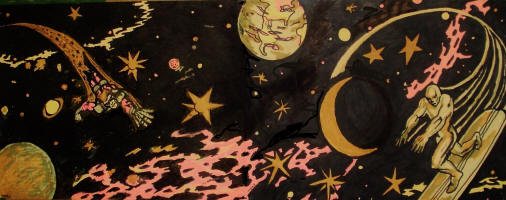
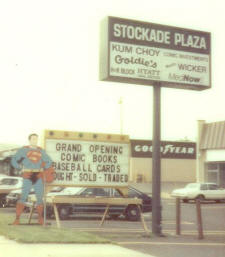 me managing Comic Investment stores in South Philly, Feasterville,
and the Roosevelt Mall in Northeast Philly. Ron's trademark was a
big Superman sign that stood guard outside. (It was stolen one day
by a prankster who stuffed it in a phone booth). Those were great
days, what better job to have, to go with my acting, than managing a
comic book store? This was also the boom-time for comic book stores.
Fans would line up waiting for us to open, when the new books came
out. People now realized that a new hot artist, or character, could
make a book more desirable. We couldn't keep back issues of John
Byrne's X-Men, Miller's Daredevil, or Perez' Teen Titans in stock.
Everyone was finding out that comics could be worth money, and they
were buying multiple copies of hot issues, speculating that they
would go up in price. I had to read all the comics, so I would know
what to order. A tough job, but someone had to do it. The 80's also
saw the beginnings of comics moving away from the old newsprint
style to better paper and larger formats like Graphic Novels and
Trade Paperbacks. Comics had come of age. Alan Moore's "The
Watchmen" made Time Magazine's Top 50 NOVELS of the 20th Century. DC
started "Marvelizing" their character's to make them more gritty,
like Miller's "Dark Knight." I still preferred the Marvel
characters, and I always said that if they could find a way to do
the special effects, Marvel characters would be the most popular in
the world.
me managing Comic Investment stores in South Philly, Feasterville,
and the Roosevelt Mall in Northeast Philly. Ron's trademark was a
big Superman sign that stood guard outside. (It was stolen one day
by a prankster who stuffed it in a phone booth). Those were great
days, what better job to have, to go with my acting, than managing a
comic book store? This was also the boom-time for comic book stores.
Fans would line up waiting for us to open, when the new books came
out. People now realized that a new hot artist, or character, could
make a book more desirable. We couldn't keep back issues of John
Byrne's X-Men, Miller's Daredevil, or Perez' Teen Titans in stock.
Everyone was finding out that comics could be worth money, and they
were buying multiple copies of hot issues, speculating that they
would go up in price. I had to read all the comics, so I would know
what to order. A tough job, but someone had to do it. The 80's also
saw the beginnings of comics moving away from the old newsprint
style to better paper and larger formats like Graphic Novels and
Trade Paperbacks. Comics had come of age. Alan Moore's "The
Watchmen" made Time Magazine's Top 50 NOVELS of the 20th Century. DC
started "Marvelizing" their character's to make them more gritty,
like Miller's "Dark Knight." I still preferred the Marvel
characters, and I always said that if they could find a way to do
the special effects, Marvel characters would be the most popular in
the world. 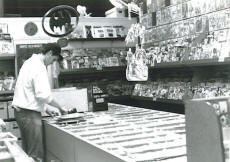 By
the end of the 80's, there were very few Golden or Silver Age comics
in the store, that Avengers #1 that sold for $6.50 in 1967 was now
hundreds of dollars. The only place you could find them for sale was
through nationwide catalogs and auctions.
By
the end of the 80's, there were very few Golden or Silver Age comics
in the store, that Avengers #1 that sold for $6.50 in 1967 was now
hundreds of dollars. The only place you could find them for sale was
through nationwide catalogs and auctions.